 Follow us on Facebook

What a Professional Wireless Site Survey Report Should Include and How to Use It
A wireless site survey report is more than heat maps. We treat it as the operations document that guides installation, validation, and maintenance. If it stops at coverage visuals, the install team is left to guess.
A professional report states the real site assumptions, application targets, AP mounting methods, cable paths, power sources, and interference findings. It defines acceptance criteria as measurable thresholds and includes a validation plan tied to those thresholds. That keeps post-installation sign-off factual instead of impression based.
The report should also become the as-built record. It should include final AP locations, channel settings, deviations, validation results, and re-survey triggers. Store it in one versioned place. That gives the maintenance team an RF baseline when walls, equipment, or client devices change.
Read the full article for the complete report checklist.

What a Business Network Assessment Should Include: Scope, Testing, and Deliverables
Business network assessments are ready to support decisions when they produce usable infrastructure documents. A report that only lists issues cannot support maintenance work orders, budget requests, or upgrade scoping.
We evaluate scope by whether it includes discovery, wired testing, wireless survey, performance baselines, and security review where applicable. The deliverables should be specific. They should include location aware inventory, physical and logical topology, wireless heat maps tied to floor plans, port level cabling records, performance data, prioritized findings, and a planning package.
That documentation gives technicians a reference for future support calls. It helps separate capacity problems from configuration problems and gives finance a clear basis for phasing work.
Read more to learn what documents to expect from a network assessment.
How to Standardize Network Design Across Multiple Locations
Standardizing networks across multiple locations is about more than matching equipment. It’s about creating one repeatable baseline for architecture, cabling, Wi-Fi, documentation, testing, and maintenance. That baseline makes troubleshooting, support, and expansion faster at every site.
A clear standard defines what stays consistent and what can change. Site-specific exceptions need to be documented, not hidden. When variations happen without records, they become technical debt that future teams have to rediscover under pressure.
The process includes validating each new location against its building and operational conditions, then testing and documenting the completed site. This keeps the network supportable long after installation.
Ascio Wireless approaches network standardization as a long-term infrastructure process. Read the full article to learn how to build a multi-site network standard.

Structured Cabling Installation: What Businesses Should Know Before Starting
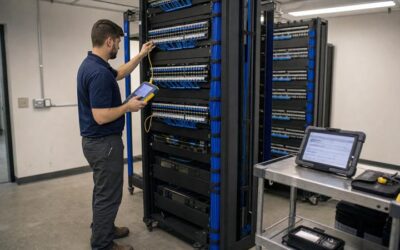
Structured cabling installation works best when the whole system is planned before any cable is pulled. Device locations, pathways, cable types, labeling, testing, and documentation all need to be part of the plan. Skipping those decisions can lead to disorganized racks and network changes that are harder to manage later.
Start with a site review and network needs assessment. Map users, devices, and critical systems, and review building constraints. Plan for reasonable growth so the infrastructure supports future changes without being overbuilt.
A complete scope includes more than outlet counts. It should cover copper or fiber selection, pathways, rack space, labeling standards, testing expectations, and closeout documentation. Ask potential installers how they validate site conditions and what records they will deliver.
Read the full article for a structured cabling checklist before your next project.

WiFi Coverage vs. Capacity: How to Know What Your Business Actually Needs
WiFi coverage determines where devices can connect. WiFi capacity determines whether the network supports everyone using it at the same time. Many businesses mistake one for the other.
Strong signal bars do not prove enough capacity. A crowded conference room can have full coverage and still struggle with video calls, cloud apps, or voice services. The issue may be capacity, wireless design, or the wired infrastructure behind the access points.
Adding access points is not always the answer. Placement, channel planning, cabling, switching, and peak demand all matter. A wireless survey can help separate coverage problems from capacity problems before you buy new equipment.
Read the full article to learn how to identify what your business WiFi actually needs.

How Network Downtime Impacts Business Operations—and How to Help Prevent It
Network downtime is rarely just an internet problem. It can interrupt cloud platforms, voice systems, shared files, and connected devices. The real impact depends on which workflows stop and how prepared the business is to recover.
Recurring slowdowns and unstable Wi-Fi are often early signs of deeper issues. Capacity limits, coverage gaps, cabling problems, and missing documentation can all contribute. A structured network assessment helps identify the weak points before the next outage forces the issue.
Start by mapping the systems and workflows that cannot afford to stop. Then prioritize improvements where downtime would cause the most operational harm. Long-term reliability comes from ongoing maintenance, testing, and documentation, not quick fixes.
Read the full article on our website to learn more.

Common Network Design Mistakes That Cause Long-Term Performance Issues
Many network issues begin with design decisions made at installation. Designing for today’s headcount instead of future demand is a common mistake. Wireless coverage and capacity are not the same thing. A strong signal does not mean the network can handle a busy area.
Skipping a site survey, treating structured cabling as a one-time cost, overlooking single points of failure, and underplanning network closets can also create long-term problems. Documentation and testing should support future maintenance, not just closeout. Recurring slowdowns, unlabeled cables, and crowded closets are signs a structured review is needed.
We help businesses plan wireless surveys, structured cabling, fiber optic cabling, and network infrastructure for long-term reliability. Contact us to discuss your network design needs.

How to Plan Network Capacity for Future Growth Without Overbuilding
Growth can expose network limits before the hardware looks old. A larger internet circuit alone will not fix an overloaded switch uplink, weak Wi-Fi design, or limited PoE capacity. Capacity planning starts with the business changes that will drive demand.
Review the full network path, including firewalls, switching, cabling, and telecom room readiness. Identify confirmed constraints before choosing upgrades. Use a build now, prepare now, defer approach: resolve bottlenecks, install infrastructure that is hard to retrofit later, and delay equipment until demand is measurable.
Read the full article for a practical phased plan.

Network Design for Warehouses vs. Offices: Key Differences in Performance and Coverage
Warehouse and office networks support different work patterns. Applying an office WiFi layout to a warehouse can lead to dead zones, dropped scanner sessions, and unreliable roaming. The design should follow how the facility operates, not just square footage.
Metal racking, high ceilings, long aisles, and loading docks change how wireless signals behave. Coverage alone does not prove capacity or reliable roaming. Wireless performance also depends on structured cabling, PoE, switching, and backbone planning. A site-specific wireless survey helps align access point placement with real work routes and device movement.
Ascio Wireless provides wireless surveys, structured cabling, and long-term network support for warehouse, office, and mixed-use facilities. Plan for the way your facility actually operates.
Read the full article for a detailed comparison of warehouse and office network design.

Network Maintenance Checklist for Businesses: Improve Reliability Over Time
Network maintenance is more than responding to outages. A reliable business network depends on scheduled reviews of devices, wireless, cabling, documentation, capacity, and recovery procedures.
Start with a baseline: document current diagrams, equipment locations, provider circuits, and known issues. Then set weekly, monthly, quarterly, and annual recurring tasks. Update records after every change so critical knowledge doesn’t sit with one person.
Recurring Wi-Fi complaints, aging equipment, or untracked changes are signs you need a longer-term plan, not another quick fix. Our maintenance checklist helps you identify developing issues before they become larger disruptions.
Read the full checklist to build a network maintenance plan.

What Happens During a Professional Network Installation (Step-by-Step)
A business network installation is not a quick setup. It follows a structured process: assessment, design, physical installation, configuration, testing, and handoff. When any step is rushed or skipped, performance issues and instability often show up later.
Proper planning starts with a network assessment that examines real conditions like building materials, coverage, and capacity needs. Cabling and hardware placement decisions made early affect long-term reliability. Testing and documentation before handoff help catch problems before they reach your daily operations.
We build networks to stay stable as your business grows. That means treating installation as an infrastructure project, not just getting equipment online.
Read the full step-by-step breakdown to see what goes into a reliable installation.

Access Point Placement Best Practices for Offices, Warehouses, and Commercial Spaces
Many business WiFi problems come back to access point placement, not the amount of equipment. Poor placement creates overlapping signals, interference, and uneven coverage. The network may look strong on paper, but users still see dropped connections and dead zones.
Coverage and capacity are different. Too few access points weaken signals. Too many placed close together increase interference. Warehouses, offices, and open commercial spaces each need a different approach. Metal racking, high ceilings, and wall layouts all affect how signals travel.
Common mistakes include mounting access points too high, ignoring building materials, and skipping validation after installation. Site surveys and heatmaps show where coverage gaps and interference actually exist. That data helps align placement with real-world usage.
Read the full article for access point placement best practices.