 Follow us on Facebook
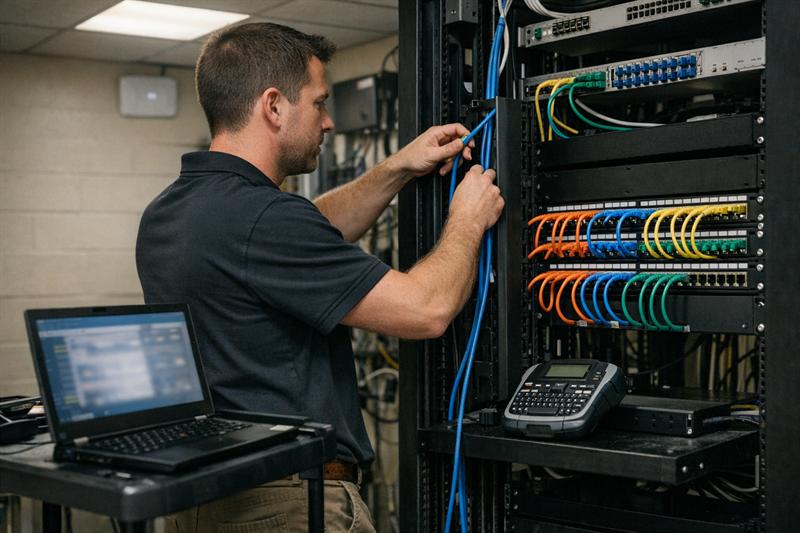
Quick Answer: Multi-site network design often breaks down when each location is built differently, leading to inconsistent performance, difficult troubleshooting, and rising maintenance costs. A more reliable approach is a standardized, scalable network model paired with the right connectivity strategy and consistent on-site execution.
Introduction
Businesses expanding into multiple locations usually expect the network to perform the same way everywhere. In practice, that rarely happens. One site runs smoothly, while another struggles with slow speeds, dropped connections, or unreliable Wi-Fi.
Bandwidth or the internet provider often gets blamed first. In many cases, the real issue comes back to inconsistent design and deployment decisions made over time.
Multi-site network design is not just about connecting locations. It is about building a repeatable system that delivers consistent performance. Without that, issues tend to multiply as more sites are added.
Why Multi-Site Network Design Is More Complex Than It Looks
The Hidden Challenges of Scaling Across Locations
No two locations are identical. Building materials, layouts, interference sources, and even ISP reliability can vary. These differences directly affect how a network performs.
A common mistake is copying a previous setup without adjusting for the new environment. That may work in the short term, but it often leads to uneven performance across locations.
Wireless networks make this especially clear. Coverage and capacity depend heavily on the physical space. That is why wireless site surveys matter more as locations scale.
Another challenge is mixed infrastructure. Some sites get upgraded while others do not. Over time, the network becomes harder to manage because each location behaves differently.
Why Inconsistency Causes Long-Term Issues
- Performance gaps: similar systems deliver different results across sites
- Troubleshooting delays: no consistent baseline makes issues harder to isolate
- Higher costs: repeated fixes replace long-term solutions
- Security exposure: inconsistent configurations can create avoidable gaps
These problems become more noticeable as the network grows. What starts as a small inconsistency can turn into a recurring issue across multiple locations.
Core Principles of Multi-Site Network Design
Standardization vs Flexibility
The goal is not identical environments. The goal is predictable ones.
Standard templates for cabling, hardware, and configuration create a consistent starting point. Flexibility should be applied where needed, not treated as the default.
This is where many networks become harder to support. Small exceptions add up, and over time the environment gets more difficult to scale and manage.
Centralized Control with Local Performance
Centralized management provides visibility across all locations. It simplifies updates, monitoring, and policy control.
At the same time, traffic decisions still need to support performance at each site. Routing everything through a central location can introduce latency and bottlenecks.
Modern designs often balance centralized control with local breakout where it makes sense. This aligns with how layered networks are structured, as outlined in core, access, and distribution layer design.
Designing for Scalability from Day One
If adding a new location requires redesigning the network, scalability is already limited.
Scalable networks rely on predefined models. Hardware, configurations, and deployment steps stay consistent from site to site.
Early shortcuts tend to create complexity later. Planning for scale up front helps keep expansion more predictable.
Choosing the Right Connectivity Model
MPLS vs SD-WAN vs Hybrid WAN
MPLS is known for consistent performance but typically comes with higher cost and less flexibility. SD-WAN uses multiple connection types and dynamically routes traffic, offering more adaptability.
Many organizations move toward hybrid WAN models. These combine private circuits with broadband or wireless connections to balance performance, cost, and flexibility.
The right choice should reflect how the business operates, not just the technology itself.
Internet-Based vs Private Connectivity
Public internet connections are widely available and cost-effective, but performance can vary. Private circuits are often used when more consistent performance is needed.
Critical applications usually benefit from predictable connectivity. Less sensitive traffic can often run over standard internet connections without issue.
When that balance is ignored, performance problems often show up as latency, instability, or inconsistent application behavior.
When Hybrid Architectures Make Sense
Hybrid designs combine multiple connection types. Broadband can handle general traffic, private circuits can support critical systems, and cellular can provide backup.
This approach improves resilience. If one connection fails, traffic can shift to another path.
Without redundancy built into connectivity, a single outage can disrupt an entire location.
Standardizing Infrastructure Across Locations
Structured Cabling Consistency
Cabling is the foundation of the network. When it is inconsistent, problems become harder to trace and resolve.
Standardizing installation, labeling, and testing creates a stable baseline across locations. This is why structured cabling design best practices matter in multi-site environments.
Poor cabling decisions made early can continue to affect performance long after deployment.
Wireless Network Design and Site Surveys
Wi-Fi performance depends on the physical environment. Reusing the same access point layout across different locations rarely produces consistent results.
Site surveys help identify interference, coverage gaps, and device density requirements. Without that step, users are more likely to experience unreliable connectivity and uneven performance.
These issues become more noticeable as device counts increase and usage grows.
Hardware and Configuration Templates
Using consistent hardware and preconfigured settings reduces variability. It also simplifies deployment and support.
A common issue is mixing vendors or models across locations. That can introduce compatibility challenges and inconsistent behavior.
Templates provide a repeatable approach that supports long-term stability.
Designing for Reliability and Redundancy
Failover Strategies
Failover planning helps the network continue operating when something fails. This can include backup connections and redundant hardware.
Without failover, a single failure can take a site offline.
Reliable networks are designed with the expectation that failures will occur and should recover quickly.
ISP Diversity and Backup Connections
Using more than one provider reduces dependence on a single connection. If one provider fails, another may maintain connectivity.
Cellular backup is commonly used to support critical operations during outages.
Lack of redundancy is a common gap in multi-location networks.
Monitoring and Alerting
Monitoring provides visibility across all locations. Without it, issues are often discovered only after users are affected.
Alerting allows teams to respond earlier, reducing downtime and limiting impact.
Networks without proactive monitoring tend to rely on reactive fixes, which increases disruption over time.
The Role of On-Site Execution and Support
Why Deployment Quality Impacts Long-Term Performance
Design sets the direction, but installation determines the outcome.
Misplaced access points, poor cable terminations, and inconsistent configurations can all lead to ongoing performance issues.
Those problems usually remain until they are corrected, regardless of how well the network was designed.
Coordinating Installations Across Multiple Locations
Consistency across locations depends on consistent execution. Standard processes and checklists help ensure each deployment follows the same model.
Without coordination, installations vary from site to site. That variation creates long-term complexity.
As more locations are added, these inconsistencies become harder to manage.
Ongoing Maintenance Considerations
Networks require ongoing maintenance to remain stable. This includes updates, audits, and performance checks.
Without regular attention, small issues can grow into larger disruptions.
A structured maintenance approach helps keep performance more consistent across all locations.
If your network behaves differently across locations, standardization is likely part of the problem.
- Some sites experience slower speeds or unstable connections
- Troubleshooting takes longer than expected
- New locations require custom fixes instead of following a standard
- Outages have a noticeable impact on operations
These are strong indicators that the network would benefit from a more structured design approach.
Common Mistakes in Multi-Location Network Design
- Treating each site as a one-off deployment
- Ignoring physical infrastructure such as cabling and equipment placement
- Lack of documentation and defined standards
- No redundancy or failover planning
- Delaying standardization until problems grow
These issues build over time. What starts as a minor gap can become a recurring operational problem across locations.
Key Takeaways
- Standardization creates consistency across locations
- Hybrid connectivity can improve flexibility and resilience
- Physical infrastructure directly affects performance
- Redundancy and monitoring support uptime
- Maintenance planning is part of long-term reliability
Conclusion
Multi-site network design becomes harder to manage when each location is built differently. That often leads to inconsistent performance, more time spent troubleshooting, and higher long-term costs.
These problems rarely stay isolated. As more locations are added, they become more difficult to correct.
Ascio Wireless, LLC focuses on building standardized, scalable network infrastructure that performs consistently across locations. From structured cabling to wireless surveys and ongoing support, the work is centered on long-term reliability and repeatable deployment.
If network performance varies between locations or expansion is becoming harder to manage, a more structured approach to design and deployment is worth considering.
Frequently Asked Questions
What is multi-site network design?
Multi-site network design is the process of creating a standardized and scalable network that connects multiple business locations. It includes connectivity, infrastructure, and centralized management. Without a structured design, performance can vary and expansion becomes more complex.
How do you connect multiple business locations securely?
Businesses often use VPNs, SD-WAN, or private WAN connections to link locations securely. These methods can help control and encrypt traffic between sites. The right choice depends on performance requirements and how critical each connection is.
What is the difference between SD-WAN and MPLS for multi-site networks?
MPLS uses private circuits to deliver consistent performance, while SD-WAN routes traffic across multiple connections dynamically. SD-WAN offers flexibility, while MPLS is often chosen for more predictable performance characteristics. Many businesses use a combination of both.
Why is network standardization important across locations?
Standardization helps create more consistent performance and simplifies management. Without it, each location can behave differently, making troubleshooting and scaling more difficult. Establishing standards early helps prevent long-term issues.
How do you scale a network as a business adds new locations?
Scaling usually requires predefined templates for hardware, configurations, and deployment. This allows new locations to follow a repeatable model instead of requiring a redesign each time. Without that structure, expansion can slow down and become more complex.
What role does cabling play in multi-site network performance?
Cabling is the physical layer of the network and directly affects reliability and speed. Poor or inconsistent cabling can lead to persistent connectivity issues. Standardizing cabling helps support more consistent performance across locations.