 Follow us on Facebook
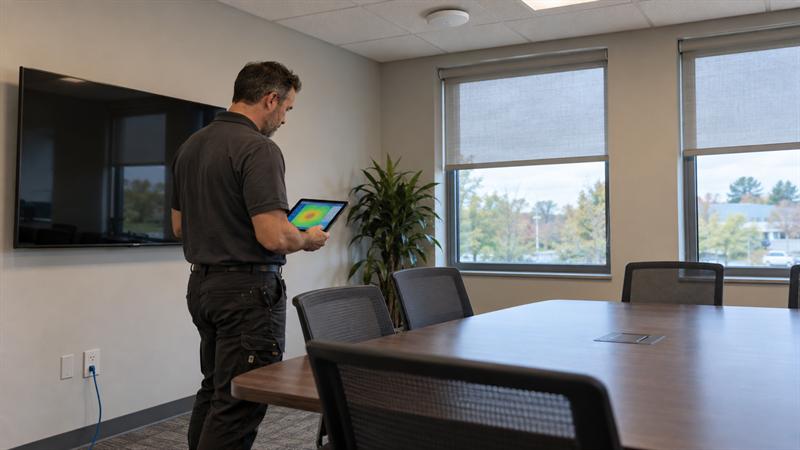
Choosing between a network assessment and a wireless site survey starts with the issue that needs explanation, not with which equipment needs replacing. A slow application, a dropped connection, or an unreliable meeting-room connection can point to a problem, but none identifies the cause on its own.
Ascio Wireless, LLC focuses on long-term wireless and network infrastructure solutions rather than quick fixes. The right investigation supports that approach by explaining what needs attention, which supporting systems are involved, and how to evaluate any changes.
Network Assessment vs Wireless Site Survey: The Short Answer
A network assessment examines broader infrastructure, configurations, and performance dependencies. A wireless site survey examines the radio-frequency (RF) environment and wireless coverage, capacity, or design requirements. Start with an assessment for shared network problems, a survey for location-related wireless questions, and coordinated testing when both areas need investigation.
- Network assessment: Common triggers include widespread slowness, wired and wireless failures, undocumented infrastructure, or upgrade planning. Typical outputs include findings, supporting evidence, and prioritized recommendations. Detailed wireless measurements are not automatically included.
- Wireless site survey: Common triggers include coverage gaps, crowded-area problems, interruptions during movement, and new-space planning. Depending on the methods used, outputs include maps, measurements, and design recommendations. Comprehensive upstream and application diagnostics are not automatically included.
Service names are not fixed specifications. The written scope determines whether an assessment includes dedicated wireless testing or a survey includes checks beyond the wireless access points themselves.
What Each Service Investigates—and What It May Not
The practical distinction is the evidence each investigation collects. Neither service should be expected to answer questions outside its testing scope.
Network Assessment: Broader Infrastructure and Dependencies
A network assessment examines the systems supporting connectivity, including the path between user devices and the services they access. Understanding what a network assessment examines helps separate this broader review from a focused wireless investigation.
Depending on the agreed scope, it may include:
- Network layout, device inventory, and relevant configurations.
- Switches, routers, firewalls, and connections between devices.
- Internet connectivity, communication delays, packet loss, and performance patterns.
- Relevant cabling, access point power, and supporting infrastructure.
A general assessment is not automatically a security audit, penetration test, cable-certification project, or exhaustive application investigation. These activities require specific methods and deliverables, so an assessment that does not include them does not produce their results.
Wireless Site Survey: RF Conditions, Coverage, and Capacity
A wireless site survey evaluates the RF environment against the way the space needs to function. Relevant factors include building materials, access point placement, interference, channel use, device density, and movement between coverage areas.
- Predictive planning: Models the expected wireless behavior using floor plans, materials, equipment, and design assumptions.
- Passive surveying: Observes wireless signals and related conditions without requiring a connected test session.
- Active testing: Uses connected clients to examine performance under defined test conditions.
- Post-installation validation: Evaluates the installed network against requirements using appropriate measurement methods.
Treating a coverage map as proof of usable performance can misdirect troubleshooting. Strong signal does not establish sufficient capacity or a healthy connection beyond the access point. Match the survey methods to the question: a coverage prediction and a connected-device test provide different evidence.
Which Starting Point Fits Your Situation?
Use connection type, location, and timing to choose the initial scope. These clues narrow the investigation; they do not replace testing.
Start with a Broader Assessment When Problems Affect Wired and Wireless Connections
If wired and wireless users experience the same failure, investigate their shared dependencies first. Repositioning access points will not address a shared upstream fault, such as a problem with the internet connection.
- Multiple connection types slow down together: Examine shared network paths, equipment, and internet connectivity.
- Several areas lose access simultaneously: Investigate common equipment and services before treating each room separately.
- Only one application fails: Compare its behavior with other applications. Targeted application testing may be more useful than either full investigation.
Make comparisons using the same application and similar timing. Comparing one user’s morning video call with another user’s afternoon file transfer can make unrelated conditions look like a shared fault.
Prioritize a Wireless Survey When Problems Follow Location, Occupancy, or Movement
If performance changes as users move through the building or as a room fills, prioritize wireless investigation. Determine whether the issue concerns coverage, capacity, interference, or how devices switch between access points.
- A room consistently loses connectivity: Examine local RF conditions and access point placement.
- A meeting area struggles when occupied: Investigate device demand, channel use, and representative workloads.
- Connections drop during movement: Examine roaming behavior and client-device requirements.
A capacity-related pattern is acceptable performance in an empty room followed by poor performance during busy periods. Testing only while the space is quiet can miss the conditions behind the complaints. Additional devices or heavier workloads can make an existing capacity limitation more disruptive.
Symptoms that appear wireless-only can also involve client devices, authentication, network configuration, or the access point’s wired uplink. If RF measurements do not explain the symptoms, extend testing to those dependencies rather than assuming more access points are needed.
Coordinate Both When Symptoms Overlap or Infrastructure Is Changing
Coordinate assessment and survey work when both the wireless design and supporting network need evaluation. Mixed symptoms, undocumented equipment, relocations, and significant layout changes are practical reasons to consider a combined scope.
For example, a proposed access point location needs more than suitable RF coverage. A wired installation using Power over Ethernet also needs a workable cable route, switch connectivity, and adequate power supplied through the network cabling.
- Define shared application, device, and coverage requirements.
- Identify wired dependencies affecting the wireless plan.
- Assign responsibility for unresolved findings and validation.
Coordinated work does not mean purchasing two comprehensive engagements by default. It means investigating the dependencies needed to make the design or repair decision.
Do not replace equipment without evidence when the same complaints keep returning. A scoped investigation is the practical next step when:
- Wired and wireless users report matching failures.
- A room works when empty but struggles during normal use.
- Access point changes have not resolved the original symptoms.
These signs call for targeted testing before another purchase or configuration change.
When Both Are Needed, How Should the Work Be Sequenced?
Sequence the work around the decision that must come first. An existing fault calls for narrowing possible causes; a new space calls for defining requirements and coordinating the design.
For Existing Problems, Narrow the Fault Domain First
Begin by identifying which part of the connection deserves closer investigation. Running every available test adds work without necessarily explaining the reported failure.
- Document: Record affected devices, locations, applications, and incident times.
- Compare: Check wired and wireless behavior under comparable conditions.
- Investigate: Review available logs and perform targeted measurements.
- Expand: Add testing where evidence leaves a specific question unresolved.
Share floor plans, inventories, and findings across the engagement. Without a shared record, separate workstreams can repeat discovery and miss how findings connect.
For New Spaces or Redesigns, Coordinate Wireless Planning with Wired Readiness
Define how the space will be used before finalizing access point locations or cable installation. Device requirements, application workloads, building layout, and infrastructure constraints belong in the same planning discussion.
- Establish coverage, capacity, and client-device requirements.
- Review floor plans and supporting infrastructure.
- Coordinate wireless design, cable routes, switching, and power.
- Validate the completed installation against the requirements.
Structured cabling and on-site network support become relevant when the design requires physical changes. Predictive planning guides installation, but measurements from the completed environment are needed to evaluate whether the design meets its intended requirements.
What Deliverables Should You Request?
Request evidence that supports a decision, not simply a collection of maps or device information. Each significant finding should explain what was observed, why it matters, and what remains unresolved.
Network Assessment Findings and Priorities
An assessment report should make its conclusions traceable to its scope and testing. Useful deliverables include:
- Relevant inventory and network-layout documentation.
- Methods, observed conditions, and testing limitations.
- Findings with supporting evidence.
- Prioritized recommendations, the reasons for those priorities, and implementation dependencies.
A related guide on network assessment scope, testing, and deliverables can help when defining the engagement. A measured issue and a suspected cause should be labeled differently: one supports corrective action, while the other requires further investigation.
Wireless Survey Maps, Measurements, and Recommendations
A useful survey report explains how its maps were produced and what decisions they support. Look for:
- Accurate floor plans, surveyed areas, and readable map legends.
- Survey methods, measurement conditions, and relevant client-device information.
- Clear identification of predicted versus measured results.
- Findings and recommendations tied to operating requirements.
Understanding what a wireless site survey report should include helps prevent overreading a coverage heat map. A favorable signal-strength image does not settle capacity or application questions. Evaluation criteria should reflect the devices and workloads the network supports, rather than a single threshold presented as suitable for every environment.
A Combined Action Plan with Validation Criteria
A combined plan should connect findings, dependencies, responsible parties, and follow-up testing. It should preserve unresolved questions rather than turning assumptions into confirmed conclusions.
For example, in a busy meeting room, testing may identify high channel use during representative demand. The report should explain whether that finding accounts for the reported symptoms, connect proposed changes to supporting infrastructure, and specify follow-up testing under comparable conditions.
Comparing a busy-period complaint with an empty-room retest alone does not establish whether the original issue was addressed. Document baseline conditions so follow-up testing and future maintenance have a meaningful reference.
Questions to Ask Before Booking Either Service
Choose a scope that explains what will be investigated and how the findings will guide action. These questions help expose gaps before work begins:
- What decision will the investigation support? Define whether the goal is locating a fault, redesigning the network, checking upgrade readiness, or validating changes.
- Which methods are included? Separate predictive planning, on-site measurements, active testing, and configuration review.
- Which devices and conditions will be represented? Include the clients, applications, and operating periods connected to the problem.
- Are upstream dependencies included? Clarify the boundary between RF testing and broader infrastructure checks.
- What access and approvals are required? Establish site access, authorized system access, and approval for potentially disruptive tests.
- What is excluded? Identify specialized testing that requires a separate scope.
- Are implementation and retesting included? Distinguish finding a problem from making and evaluating changes.
Site size, layout, location count, methods, documentation quality, and access constraints influence effort. A fixed duration alone does not show whether the investigation fits the problem.
Ascio Wireless, LLC’s approach centers on long-term infrastructure rather than isolated quick fixes. Its wireless surveys, networking, structured cabling, on-site support, and maintenance offerings address different stages of that work. A scope discussion should connect the investigation to the support needed for recommended changes, without assuming every service or test belongs in every project.
Frequently Asked Questions
Does a Network Assessment Include a Wireless Site Survey?
Sometimes, but a dedicated wireless site survey is not automatically included. An assessment might review access point configurations and connectivity without collecting location-based RF measurements. A survey adds a defined wireless investigation, such as coverage mapping or active client testing. The distinction is the testing performed and the evidence delivered, not the service label.
Can a Wireless Site Survey Explain Slow Wi-Fi When Signal Strength Looks Good?
Yes, if its scope includes the relevant testing. Strong signal does not establish adequate capacity or rule out interference and client-related problems. Active testing provides evidence beyond a signal-strength map, but upstream connectivity or application issues may require broader investigation. Receiving a strong signal and having a healthy end-to-end connection are different things.
Can a Wi-Fi Heat Map Replace a Professional Network Assessment?
No, not when the question concerns broader network health. A heat map visualizes a particular wireless measurement or prediction, such as signal coverage. It does not by itself evaluate switching, routing, internet connectivity, or application behavior. Its usefulness depends on what it displays, how the data was obtained, and which question needs answering.
Do You Need Both Services Before Replacing Access Points or Moving Offices?
Not always. The need depends on what is changing and what is known about the supporting infrastructure. A relocation may require wireless planning alongside cable-route, switch-connectivity, and power checks. Where infrastructure is documented and suitable, targeted readiness checks may be sufficient rather than two separate, comprehensive engagements.
What Should a Business Prepare Before an Assessment or Survey?
Prepare available floor plans, affected locations, symptom timing, device information, application requirements, and details of recent network changes. These help distinguish location-specific issues from broader patterns and identify representative testing conditions. Arrange authorized access securely; credentials should not be included in ordinary intake documents.
Key Takeaways
- Start broadly for shared failures: Problems affecting wired and wireless users warrant investigation of common dependencies.
- Focus wireless testing on location-related patterns: Coverage, occupancy, and movement help define the survey questions.
- Coordinate overlapping work: Wireless design and supporting cabling, switching, and power need to be evaluated together where those dependencies apply.
- Require evidence and validation: Useful deliverables connect findings to actions and establish how changes will be evaluated.
Conclusion: Choose the Investigation That Guides the Next Decision
Contact Ascio Wireless, LLC to discuss the investigation scope before another equipment purchase or redesign. The core problem is uncertainty about where the failure begins. Replacing access points will not correct a shared upstream fault, and testing an empty room alone will not explain performance under busy-period demand.
Bring three details: affected locations, whether wired connections also fail, and when symptoms occur. Request a written scope covering testing, deliverables, exclusions, and validation. This gives the conversation a concrete basis for defining wireless surveys, networking support, or coordinated work, with the goal of addressing the underlying infrastructure rather than repeating an unverified fix.