 Follow us on Facebook

Quick Answer: An assessment becomes a work plan when each finding is written into a register, scored against risk, dependency, effort, and funding, and then placed in a phase that can be installed inside one building-access window. The sequence matters more than the list.
Most assessment reports are accurate and still unused. They describe the state of a network in the language of conditions, while approval and scheduling happen in the language of work. Closing that gap is a translation task, and it has a repeatable shape.
Why Findings Stall After the Report Lands
A network assessment produces findings that combine measurements, site observations, and a written document package. What it does not produce is a sequence. The report will say that a warehouse corner shows weak signal, that a closet switch is past its replacement cycle, and that a branch office saturates its uplink every afternoon. Each statement is true, and none of them tells you what to schedule in March.
If the review itself is still an open question, what a network assessment is and when a business needs one covers the scope decision. Once the report exists, the useful question changes from what is wrong to what gets fixed, in what order, and paid from which line.
Build a Findings Register Before Choosing Projects
Turn the report into rows. A findings register lists each item with its location, the condition observed, the users or systems affected, and the proposed change. Four columns, one row per finding, nothing else.
The format looks clerical and does more work than it appears to. A row can be sorted by location when a contractor is already on site, quoted in a budget request without rewriting the prose, and counted when someone asks how many items remain open. It also forces vague findings into a decision: if a row cannot name the affected users or the change it proposes, it is an observation rather than a work item.
Compare the register against what a business network assessment should include before sorting begins. A report that skipped its documentation section leaves gaps in the register that no amount of prioritization can fill.
How to Prioritize Network Assessment Recommendations
Four criteria hold up when a plan is reviewed by someone who was not in the room:
- Risk to operations. What stops working, and for whom, if the item waits another quarter.
- Dependency on other work. Whether the fix stands on its own or only after a cabling, switching, or addressing change lands first.
- Effort and disruption. Installation time, ceiling and closet access, and the hours the business loses while the work is under way.
- Funding window. Which budget cycle the item can realistically be paid from, and whether a partial spend now creates rework later.
Sort in that order and one awkward result appears quickly: a serious finding that depends on structural work is not first on the schedule. Severity sets the conversation; dependency sets the calendar. Teams that prioritize network assessment recommendations on severity alone tend to fund the same repair twice, once as a workaround and again when the underlying layer is finally replaced.
Score the rows and write the scores down next to them. A register with visible criteria turns a disagreement about priorities into a disagreement about one criterion on one row, which is a far shorter meeting. It also leaves a record of why a low-risk item moved ahead of a loud one when the reason was a dependency rather than a preference.
Sort the Work Into Three Buckets
Once the rows are scored, group them by the kind of work they require. The grouping is what makes a phase boundary possible.
Stabilization work uses configuration, channel and power settings, addressing, and documentation inside the hardware already installed. Most of it sits in the switching and wireless estate that business networking services already cover, and it usually fits a maintenance window without a purchase order.
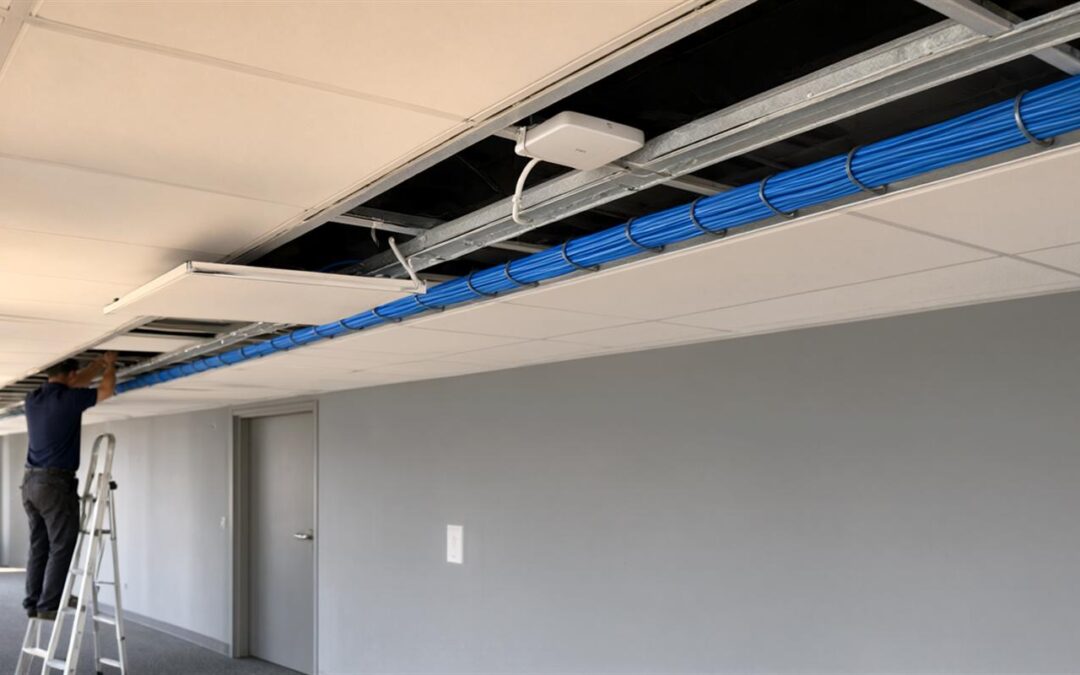
Structural work changes cabling, pathways, or access point locations, and it needs installation time and physical access. This is the bucket that moves dates, because it depends on a crew, a lift, and a building willing to be interrupted.
Refresh work replaces hardware or adds capacity, and it follows the equipment lifecycle and the budget cycle rather than a single fault. A switch sitting one failure away from an outage belongs here even if nothing is broken today.
Sequence Phases Around Dependencies and Access
Some fixes hold only after an earlier layer changes. Wireless tuning cannot compensate for an undersized cabling path, no matter how carefully the channels are set. The same logic runs through addressing, segmentation, and monitoring: each depends on the layer beneath it being stable enough to measure.
Access is the second constraint. Installation windows depend on building access, business hours, and coordination with landlords or tenants, and a window that looked open in the plan can close when a tenant books the loading dock or a landlord schedules fire-system testing. Pathway and cabling work is where that pressure lands first, which is why structured cabling design and installation is worth settling before installation dates are agreed with anyone.
Choose phase boundaries so that a phase can finish inside one window and one approval cycle. A phase that stops halfway through a cabling run leaves the network in a state nobody wants to test, document, or inherit.
A phase should also be a single kind of work. Mixing a switch refresh with a wireless redesign in one phase makes the acceptance test ambiguous, because a weak result could belong to either. One bucket, one dependency layer, one test.
From Network Assessment to Upgrade Plan: Scope, Budget, and Approval
The test of the plan is whether an approver can read it without a briefing. Each line should state what changes, what it touches, when it can be scheduled, and what it costs relative to the items deferred.
The route from network assessment to upgrade plan runs through the register, not around it. If a line item cannot be traced back to a row, a criterion, and a phase, it is a wish list entry with a price attached.
Proposal review belongs at this stage rather than earlier. When comparing quotes, evaluating a network assessment proposal on whether its scope matches the phase it prices is more useful than comparing totals, because a low total for half a phase is not a saving.
Expect the approval conversation to run on exclusions rather than preferences. The question is rarely whether a wireless redesign is worth doing; it is whether the cabling phase in front of it can be paid for now. A plan that shows the dependency plainly answers that question before it is asked.
Close Each Phase With Evidence
Each phase closes with testing that compares conditions against the requirements written into the plan. Those requirements have to exist before installation, not after it. If the standard is agreed once the work is finished, acceptance becomes a matter of opinion and the next phase starts on an unverified base.
Keep the results with the register. A phase that closes with a test record gives the following phase a starting condition, and gives whoever inherits the network a date, a method, and a measurement rather than a memory.
Give Deferred Items a Trigger
A deferred item needs a trigger and a review date, or it drops out of the plan without a decision. The trigger names the event that makes the item actionable. The review date makes someone look even if the event never arrives.
Deferring for budget and deferring for dependency are different decisions and deserve different triggers. A budget deferral waits on a funding cycle. A dependency deferral waits on another phase closing, and its review date should sit just after that phase’s acceptance test rather than at the end of the year.
Key Takeaways
Four steps separate a report from a funded plan:
- Convert every finding into a register row with a location, a condition, an affected user or system, and a proposed change.
- Prioritize network assessment recommendations on risk, dependency, effort, and funding window, then let dependency set the calendar.
- Group the work into stabilization, structural, and refresh buckets so phases have natural edges.
- Attach a trigger and a review date to anything deferred, and close every phase with a test record.
Next Step
The work plan is the useful artifact, not the report. Once every finding has a row, a score, a phase, and a test that closes it, the assessment stops describing a problem and starts reading as a schedule someone can approve.
ASCIO Wireless works on business wireless, structured cabling, networking, and ongoing network maintenance. A phased plan usually spans those categories at once, which is why the sequencing conversation is worth having before the first purchase order. If the register is written and the phases are still open, request a free consultation to walk the findings through the sequence.