 Follow us on Facebook

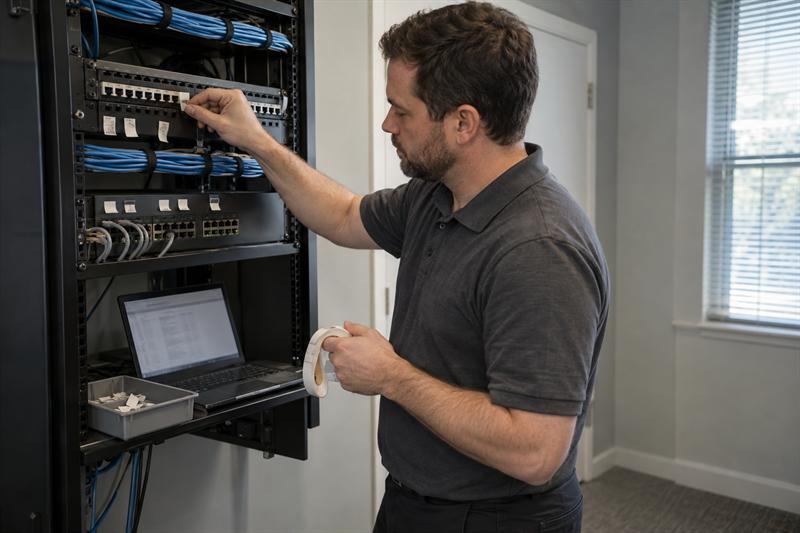
Ascio Wireless, LLC supports businesses that need network infrastructure to stay maintainable over time, and this issue shows up early in many multi-location environments. A network can be technically solid and still be difficult to support when each site names equipment differently, closet labels are inconsistent, and documentation no longer matches what is in the field.
That usually starts small. One location is installed by a different contractor. Another uses informal closet names. A refresh introduces new hardware, but the old model numbers stay embedded in device names. Over time, support slows down, handoffs become harder, and routine changes create avoidable confusion.
Why Multi-Site Network Naming Breaks Down
Multi-site naming usually breaks down because growth moves faster than standardization. Different vendors, internal IT teams, expansion phases, and inherited infrastructure all bring their own naming habits. Once those habits spread across several locations, the network stops following one clear system.
A common pattern is one site naming switches by room, another by rack, and another by model number. None of those choices feels serious at first. The problem starts when teams need to support devices remotely and cannot tell whether a name refers to a role, a location, or an older hardware generation.
This often gets worse when physical labels, hostnames, and diagrams are updated at different times. If a switch label says one thing, the hostname says another, and the spreadsheet still shows an old rack position, support teams can lose time before the real issue is even identified.
- Inherited sites bring mixed standards into the same environment
- Hardware refreshes leave outdated model-based names behind
- Closet and rack labels drift after remodels or expansions
- Temporary shortcuts become permanent naming habits
That is why standardizing network design across multiple locations matters at the execution level, not only at the design level. Naming is part of what keeps a network supportable after installation.
What a Good Multi-Site Naming Convention Needs to Do
A good naming convention needs to stay useful after equipment is replaced, moved, expanded, or documented by different teams. If the standard only works during the initial install, it is not strong enough for long-term support.
- Be readable without becoming overly detailed
- Scale across new locations without creating new naming logic
- Stay stable when hardware models change
- Separate physical location from logical role
- Support troubleshooting, maintenance, and handoff work
The most practical approach is usually the simplest one. Names should identify what a device is in a durable way, while documentation holds the detail that changes more often. That distinction is where many naming standards either hold up or start to drift.
Build the Naming Standard in Layers
The clearest multi-site naming standards separate naming into layers. That keeps the hostname from doing too much and gives each part of the system a defined role.
At a minimum, businesses should think in terms of site names, device hostnames, printed labels, and documentation records. When those are treated as separate but connected layers, the standard is easier to maintain across locations.
Site Naming Conventions
Site names should be short, stable, and tied to an official internal reference. In most cases, that means using a consistent site code rather than local nicknames or shorthand that only one team understands.
A branch office, warehouse, and headquarters can all follow the same site code logic even when the physical environments are very different. A site identifier should not change because a location is remodeled, reorganized, or refreshed. If the site code shifts too easily, everything linked to it becomes harder to manage.
Device Hostname Standards
Device hostnames should identify the site first, then the device role, then a limited physical or sequence reference if that detail is actually useful. In many business environments, that is easier to maintain than long names filled with model numbers, project names, or user-specific labels.
A common structure is site code plus function plus closet or rack plus number. That pattern stays readable and gives support teams a predictable format. It also helps distinguish switches, firewalls, routers, and access points without turning the hostname into a record of every device detail.
Ascio Wireless, LLC regularly runs into environments where the hostname carries so much detail that it becomes wrong as soon as the device is moved or replaced. When that happens, teams either leave the outdated name in place or rename it inconsistently. Both create more drift over time.
Rack, Closet, MDF, and IDF Naming
Physical spaces need their own naming standard because field support depends on them. MDF and IDF names should stay consistent across cabling records, rack labels, diagrams, and support notes.
This matters even more in environments with ongoing structured cabling work, site expansion, or mixed generations of installations. If the closet name in documentation does not match the label technicians see on site, tracing and change work slows down immediately.
That is where physical infrastructure and network support meet. A naming standard is easier to maintain when closet and rack labels are treated as part of the infrastructure, not as an afterthought.
Port and Patch Panel Labeling
Port labels and patch panel labels should support traceability, not repeat every hostname detail. Their job is to help teams follow a connection path quickly during troubleshooting, moves, or adds.
A practical standard usually ties patch panel labels to a known rack, panel, and port structure that aligns with documentation. Problems start when labels are handwritten inconsistently or updated in only one place. Once labels drift from the documentation set, every change request takes longer than it should.
Strong labeling standards work best when paired with network documentation best practices for long-term maintainability. Labels help teams find the connection in the field. Documentation explains the broader context around that connection.
VLAN Naming Conventions
VLAN names should describe purpose clearly without being tied to temporary conditions. The VLAN ID and the VLAN name serve different roles, and both should stay understandable across sites.
A VLAN name based on role or service type usually lasts longer than one tied to a temporary rollout or a department name that later changes. This becomes more important in environments that connect on-premises infrastructure with cloud systems, where naming consistency supports cleaner operations across platforms.
Wireless Access Point Naming
Wireless access point names should match the way teams actually locate and support them. In many sites, that means using the site code and a floor, zone, or area reference that stays useful during surveys, troubleshooting, and future maintenance.
That matters most when wireless performance depends on physical placement. For businesses that rely on post-install validation or future optimization, AP naming should align with survey records and coverage references rather than ad hoc controller labels created after deployment.
If your naming standard already feels unreliable, the signs are usually easy to spot.
- Support teams rely on tribal knowledge to identify devices at certain sites
- Hostnames, closet labels, and documentation do not match cleanly
- Refresh projects keep old naming logic because renaming feels too risky
- Remote troubleshooting starts with figuring out what the device actually is
If these signs are showing up, a cleanup and documentation-driven standard is usually needed before the next expansion or upgrade adds another layer of confusion.
What Not to Put in a Device Name
Do not put model numbers, temporary project names, user names, or other changing details into the hostname. Those details may feel helpful during deployment, but they usually create problems later.
Model numbers are one of the most common mistakes. A device gets replaced, the name no longer matches the hardware, and the team is left deciding whether to rename the device or live with a misleading hostname. Either option creates friction.
Overly descriptive names usually age badly for the same reason. The more a hostname tries to store every physical and operational detail, the faster it becomes partially wrong. That leads to exceptions, manual workarounds, and eventually a naming system that people stop trusting.
A Practical Format for Multi-Site Device Names
A practical format keeps only the identifiers that are stable and immediately useful. In many environments, that means site code plus device role plus physical area or sequence number.
For example, a switch might use a site code, switch role, closet reference, and sequence number. A firewall pair might use the site code, firewall role, and a simple identifier for primary and secondary. An access point might use the site code and zone reference. The exact syntax matters less than the consistency behind it.
The key decision is what should stay stable when the hardware changes. If a switch is replaced in the same role at the same site, the name usually should not change just because the model changed. That is one of the clearest ways to reduce operational churn.
Documentation Standards That Support the Naming Convention
Naming standards only hold up when documentation follows the same logic. If documentation treats the hostname, asset tag, rack position, and device role as separate fields, teams can keep names concise without losing operational detail.
A strong documentation set should track the hostname, asset label, site code, room or closet, rack position, management IP, device role, and relevant notes. That gives teams a reliable reference point during support, maintenance, and replacement work.
Another issue that comes up after project handoffs is that the physical install is complete, but the naming logic is not captured well enough for long-term support. That is why a thorough network project handoff checklist matters. Without that discipline, naming drift can start early and spread faster.
How to Record Exceptions Without Losing Standardization
Exceptions should be documented deliberately or they can become the real standard. In multi-site networks, some exceptions are unavoidable during migrations, inherited site support, or vendor-specific constraints. The issue is not the exception itself. The issue is leaving it informal.
A useful exception record should capture what is different, why it is different, who approved it, and when it should be reviewed again. That helps keep temporary workarounds from turning into permanent inconsistency.
This is where standards usually weaken. One unusual site gets handled differently, then another team copies that workaround elsewhere because it seems faster. Before long, the written standard still exists, but the network is operating on exceptions instead.
Common Mistakes in Multi-Site Naming Standards
One common mistake is mixing physical location and logical role inconsistently. A switch at one site is named by closet, another by function, and another by hardware generation. The result is a pattern that looks standardized until someone has to use it under pressure.
Another mistake is renaming devices without updating documentation and field labels at the same time. That creates the kind of mismatch that slows troubleshooting immediately. Reusing names after replacements can create the same problem if teams lose track of which records belong to the current device and which belong to the old one.
If these issues are ignored, the standard stops being a tool and becomes another source of uncertainty. That usually leads to longer troubleshooting cycles and more reliance on memory instead of reliable records.
How to Roll Out the Standard Across Existing Sites
The most practical rollout starts with an audit, not a mass rename. Teams should review current hostnames, field labels, closet names, patching references, and documentation to find where the biggest mismatches already exist.
From there, prioritize critical sites, support-heavy infrastructure, and upcoming refreshes. This approach is usually cleaner than trying to rename every device in every location at once. A staged rollout creates less operational risk and gives teams a chance to test the standard against real maintenance work.
This also aligns with broader network design for multi-location businesses. Naming is easier to standardize when it is tied to real implementation events such as upgrades, surveys, maintenance cycles, and cabling changes rather than treated as a separate documentation task.
Key Takeaways
- Multi-site network naming conventions work best when they use short, stable identifiers.
- Hostnames should not carry every detail. Documentation should hold the details that change more often.
- Closet labels, rack names, port labels, and documentation need to align with the same standard.
- Exceptions should be logged intentionally or they spread into the rest of the environment.
- A staged rollout is usually more effective than a one-time network-wide rename.
Conclusion
The real problem is not simply inconsistent names. It is the operational confusion that follows when names, labels, and documentation stop matching across multiple locations. Once that drift sets in, troubleshooting takes longer, refreshes become harder to manage, and support starts depending on memory instead of a reliable standard.
If that is left unaddressed, cleanup becomes more difficult with every added site, vendor handoff, and hardware replacement. This is where a long-term infrastructure approach matters. Ascio Wireless, LLC helps businesses bring structure to wireless, cabling, and network environments that need to stay supportable over time, not just look organized during installation.
If your team is already dealing with naming drift, mismatched records, or site-to-site inconsistency, this is a practical time to address it before the next project adds more confusion. Ascio Wireless, LLC can help review the current environment, align naming with documentation and field labeling, and support a standard that holds up through ongoing maintenance and growth.
Company Approach
Ascio Wireless, LLC treats naming standards as part of infrastructure maintainability, not as a paperwork exercise. That matters because naming problems rarely stay isolated. They usually connect to incomplete handoff records, inconsistent closet labeling, aging cabling references, or wireless and network changes that were never fully normalized across sites.
In practice, the strongest results usually come from tying naming cleanup to real infrastructure work. That can include network assessments, wireless surveys, structured cabling projects, on-site support, and network maintenance activities where labels, documentation, and field conditions are reviewed together. That approach is more durable than trying to solve a physical infrastructure problem from a spreadsheet alone.
FAQ
What is the best format for multi-site network naming conventions?
The best format is a short structure built around stable identifiers, usually site code first, then device role, then a limited location or sequence reference if that detail is truly useful. The goal is not to fit every fact into the name. The goal is to keep the name accurate through support work, hardware refreshes, and site growth.
For example, a name based on site code and device role remains useful after a switch replacement. A name based on a specific hardware model becomes inaccurate as soon as the device is upgraded. That is the distinction that matters most. Stable identity belongs in the name. Changing details belong in documentation.
Should network device names include the hardware model number?
Usually no. Model numbers change too often to be a reliable part of a long-term naming standard.
This is one of the most common cleanup issues in real environments. A site refresh replaces the device, but the old model remains in the hostname because renaming everything introduces more work and risk. That leaves the business with a name that looks specific but points to outdated information. If the model matters, it should be stored in the inventory or documentation record, not used as the core identifier.
How do you name switches and access points across multiple locations?
Switches and access points should follow the same site-first standard, but they usually need different supporting details. Switches often benefit from a closet, rack, or sequence reference because they are tied closely to physical infrastructure. Access points usually benefit from floor, zone, or area references because support and survey work depends on physical coverage context.
What commonly gets misunderstood is that consistency does not mean every device type uses identical naming components. It means each device type follows the same logic about what is stable, what is useful, and what belongs in documentation instead of the name itself.
What should be documented if a site cannot follow the standard exactly?
If a site cannot follow the standard exactly, the record should clearly state what differs, why it differs, who approved the exception, and when it should be reviewed. That turns a workaround into a managed exception instead of an undocumented inconsistency.
This matters because exceptions tend to spread. One unusual site gets handled differently, then another team copies the same approach somewhere else because it seems convenient. Once that happens, the exception is no longer isolated. It starts reshaping the standard in practice, even if the written standard never changed.
How do you keep labels, hostnames, and documentation consistent?
They stay consistent when each one has a defined purpose and all three are updated as part of the same change process. The hostname identifies the device in a stable way. The field label helps someone find it physically. The documentation stores the broader detail that should not be packed into the name.
Problems usually start when one of those gets updated on its own. A switch is replaced and the hostname is correct, but the label still reflects the old reference and the documentation was never revised. At that point, the issue is no longer naming alone. It is a process gap that affects support, handoff, and maintenance.
When should a business update its network naming standard?
A business should update its naming standard when the current one no longer reflects how the network is being operated and maintained. That usually becomes clear during growth, acquisitions, refresh cycles, inherited site support, or repeated troubleshooting where teams rely on memory because the records no longer line up with reality.
The important point is that the trigger is not age by itself. The trigger is operational drift. If the naming standard creates hesitation instead of clarity, or if different sites are following different logic, the standard is already weakening. That usually means the business needs a cleanup approach tied to real infrastructure work, not just a document rewrite.